There’s an app for that: atomistic materials calculations made more accessible by the AiiDAlab Quantum ESPRESSO app
By Nicola Nosengo/NCCR MARVEL
Advanced atomistic simulations of materials are now more accessible than ever: all you need is a web browser. A group of scientists from Switzerland, Germany, Italy and the UK, coordinated by NCCR MARVEL members, has introduced a web-based app that allows users to handle first-principles, atomistic simulations (typically based on density-functional theory, the go-to computational method for simulating the electronic structure and key properties of materials) easily, without sacrificing scientific rigor.
The AiiDAlab Quantum ESPRESSO app, described in a recent publication in npj Computational Materials, can run not only isolated calculations but also complete, end-to-end computational workflows involving multiple passages over several different materials, lowering the barrier for both experimentalists and computational experts. This is achieved through the tight integration of the widely-used Quantum ESPRESSO simulation software package with the AiiDA engine, a workflow-management system to help automate complex simulations in materials science and a core pillar of NCCR MARVEL, which has provided substantial support to its development alongside contributions from the broader community.
At the heart of the platform is a graphical interface that hides technical complexity while remaining scientifically transparent. “A key goal was to provide a smooth and robust experience that guides users through complex simulations without requiring them to become experts in the underlying infrastructure,” explains co–first author Edan Bainglass from the Paul Scherrer Institute in Switzerland. From structure preparation to final analysis, simulations are launched and monitored through a clear browser-based workflow, while execution, driven by AiiDA, happens transparently on local or remote high-performance computing resources.
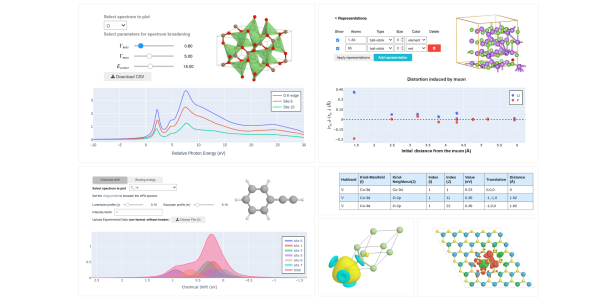
Overview of result panels from various plugins in the AiiDAlab Quantum Espresso app. From https://doi.org/10.1038/s41524-025-01936-4
The app enables automated workflows that may involve hundreds or even thousands of individual calculations. “We wanted to go well beyond traditional GUIs,” says Giovanni Pizzi, also at PSI in Switzerland and corresponding author of the article. “The app is designed to support advanced, large-scale workflows that are essential for today’s experimental research, including studies connected to large-scale facilities such as PSI and other international infrastructures.” This capability makes it possible to compute electronic, vibrational, and spectroscopic properties in a systematic and reproducible manner.
Another defining aspect of the platform is that it is FAIR (Findable, Accessible, Interoperable and Reusable) by design. Every calculation performed through the app is tracked by AiiDA, automatically recording inputs, outputs, codes, and their interdependencies. “Reproducibility is not an afterthought here, but it is built into every execution,” emphasizes Carlo Pignedoli, also corresponding author from Empa-Swiss Federal Laboratories for Materials Science and Technology. With a single click, users can export not only raw input and output files, but also complete AiiDA packages that make it easy to share, publish, or reuse computational results.
Beyond its immediate functionality, the AiiDAlab Quantum ESPRESSO app is conceived as a living ecosystem, allowing users to add plugins to expand specific functionalities. In addition to a core plugin for calculating electronic band structures, external plugins are already available for vibrational spectroscopy, X-ray absorption, X-ray photoelectric spectroscopy, muon spectroscopy, and a Wannierization plugin for automatic generation of maximally localized Wannier functions. Such a plugin interface allows computational scientists to develop and deploy new workflows and graphical components.
“This modular design makes it possible for the community to continuously extend the platform,” notes co–first author Xing Wang, “ensuring that new methods and capabilities can be adopted quickly without reinventing existing infrastructure.”
By combining accessibility, automation, and full data provenance, the AiiDAlab Quantum ESPRESSO app represents a step towards more open, reproducible, and collaborative materials research.
The work is the result of a coordinated development effort of over 25 researchers and was driven by one of the core goals of the NCCR MARVEL, directed by Nicola Marzari, of building a digital infrastructure for 21st-century science - where simulations, data, and increasingly AI and machine learning are seamlessly available to the entire research community and not just the computational experts.
Beside the NCCR MARVEL, the effort has been supported by a broad range of national and European initiatives, including the EU Center of Excellence MaX, the Italian PNRR MUR projects ECOSISTER and ICSC, and several Swiss National Science Foundation (SNSF) grants and European Union funding programmes (MarketPlace, DOME4.0, OpenModel, BIG-MAP), highlighting the strategic importance of shared, open research infrastructures for the future of materials discovery.
Reference
Wang, X., Bainglass, E., Bonacci, M. et al. Making atomistic materials calculations accessible with the AiiDAlab Quantum ESPRESSO app. npj Comput Mater 12, 72 (2026). https://doi.org/10.1038/s41524-025-01936-4