
Screening reveals dozens new candidates for solid electrolytes
By Nicola Nosengo/NCCR MARVEL
Solid state lithium-ion batteries could be a key ingredient of mass electrification – if they can be made to work. Compared to the current batteries that use liquid electrolytes to move charges around, those with a solid electrolyte would be safer and would pack more energy in the same space – a game changer for electric vehicles, for example. But as of today, there is no solid-state material that has all the needed requirements for this application.
Experimental and computational methods have been used to explore specific families of materials in search of good candidates, but they only scratched the surface.
In a new article in Energy and Environmental Science (highlighted as a “hot” article by the journal’s editors), scientists in Nicola Marzari’s lab at EPFL present a computational workflow that they used to screen thousands of materials belonging to vastly different families and simulate their electrolytic properties, in the end identifying a handful of promising candidates for solid lithium-ion batteries.
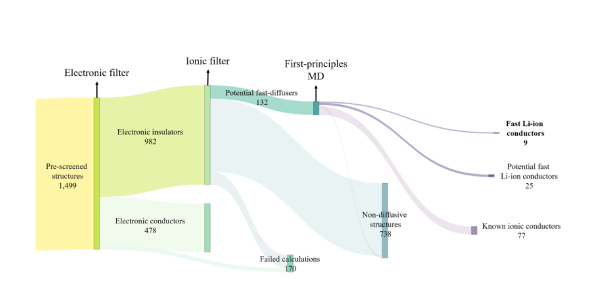
Flowchart of the workflow that only shows electronic structure calculations. Beginning with 1,499 pre-screened structures, 9 most promising candidates are identified. Each node represents a filter based on ab initio methods that eliminates undesirable structures, while potentially suitable structures advance to the next filter. From https://doi.org/10.1039/D5EE07336G.
To start with, the group selected over 30,000 compounds containing lithium from three of the main databases of experimental structures: the Crystallography Open Database (COD), the Inorganic Crystal Structure Database (ICSD) and the Materials Platform for Data Science (MPDS). Before even doing any calculation, they filtered out compounds that were unlikely to result in good battery candidates (such as organic molecules) or that could not be accurately modelled in the following steps (like those containing hydrogen).
What was left was almost 1,500 structures, for which the team calculated band gaps with Density Functional Theory (DFT)– the standard method for electronic structure calculations - to select those that act as electronic insulators. The next step was simulating the ionic conductivity, the fundamental property of an electrolyte. This is the job of Molecular Dynamics (MD), a simulation technique that describes the movements of atoms and molecules over time.
The team started with an approximated version called “pinball model”, that treats all lithium atoms as ionised “pinballs” moving in a lattice of all non-lithium atoms fixed at the equilibrium positions with no change in charge density. This technique allowed to select 132 structures with ionic conductivity above the desired threshold, 77 of which turned out to be well-known lithium conductors. “This was a nice confirmation that the method works”, says Tushar Singh Thakur, a scientist in Marzari’s lab and co-author of the paper, with Loris Ercole and Marzari himself. “But we were mostly interested in exploring new candidates”.
The remaining materials were more thoroughly explored with first-principles Molecular Dynamics, a more powerful and computationally expensive method, and divided in two lists: 25 compounds that seem to be fast conductors at high temperatures and could, when tested in actual experiments, work well at room temperature too; and 9 materials, the most promising ones, that according to simulations are fast conductors of lithium ions even at low temperature. The researchers also filed patent applications for materials in both lists, where lithium oxides and halides have the lion’s share.
A new development of the same method is already in the pipeline, says Thakur. “Thanks to all the data we gathered during this screening, we developed a protocol to fine-tune universal machine learning interatomic potentials to lithium compounds”, he explains. In a second article soon to be submitted, the team has essentially repeated the screening using machine learning methods instead of the pinball approximation, finding even more materials.
Reference
Tushar Singh Thakur, Loris Ercole, Nicola Marzari, Novel fast Li-ion conductors for solid-state electrolytes from first-principles, Energy Environ. Sci., 2026, Advance Article, DOI https://doi.org/10.1039/D5EE07336G.