Nicola Marzari and Ben Feringa win 2025 Feynman Prizes
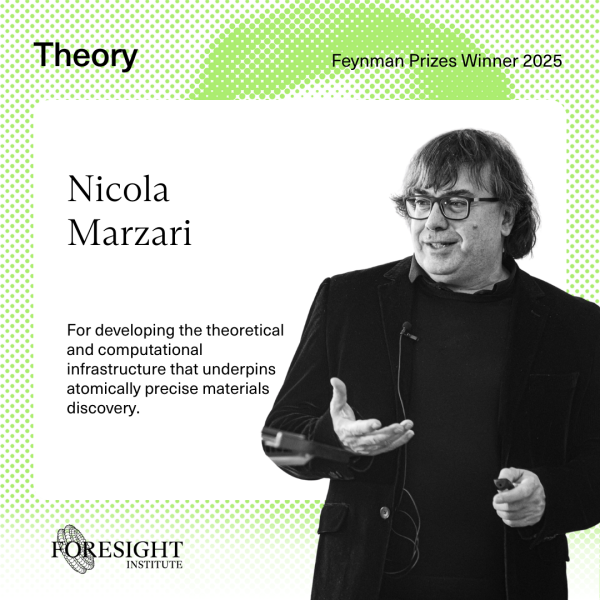
Source: Foresight Institute
Foresight Institute has just announced the winners of the 2025 Feynman Prizes for outstanding contributions to nanotechnology: they are MARVEL Director Nicola Marzari, professor at EPFL and laboratory head at the Paul Scherrer Institute, and Nobel laureate Ben L. Feringa from the University of Groeningen.
Established in 1993, the Feynman Prizes recognize exceptional accomplishments in nanotechnology. It is awarded for excellence in theory and experiment to the researchers whose recent work has most advanced the achievement of Feynman’s goal for nanotechnology: molecular manufacturing, defined as the construction of atomically-precise products through the use of molecular machine systems.
The motivation for the Theory Prize to Nicola Marzari is “for developing the theoretical and computational infrastructure that underpins modern atomically precise materials discovery”.
As for Feringa, who in 2016 received the Nobel Prize for Chemistry, the Experiment prize recognizes that he has been a pioneer in molecular nanoscience exploring molecular switches and motors, initiating one of the most important fundamental developments in the field of chemistry in the past decades i.e. the control of molecular motion.
Both winners will deliver online seminars with early next year (exact dates to be announced).
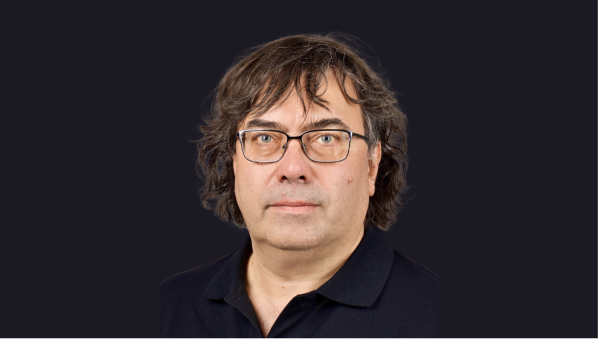
Nicola Marzari
Nicola Marzari’s biography
Nicola Marzari’s research is dedicated to the development and application of electronic-structure simulations to understand, predict, and design the properties and performance of novel materials and devices.
He holds the Chair of Theory and Simulation of Materials at EPFL, where he also directs the National Centre on Computational Design and Discovery of Novel Materials MARVEL. He heads the Laboratory for Materials Simulations at the Paul Scherrer Institut and holds an Excellence Chair at the University of Bremen. He took up the post of Cavendish Professor of Physics at the University of Cambridge (UK) in September 2025, transitioning there in 2026. Previously, he held the Toyota Chair for Materials Processing at the Massachusetts Institute of Technology and was the inaugural Statutory Chair of Materials Modelling at the University of Oxford (UK). He received a Laurea in Physics from the University of Trieste and a PhD in Physics from the University of Cambridge.
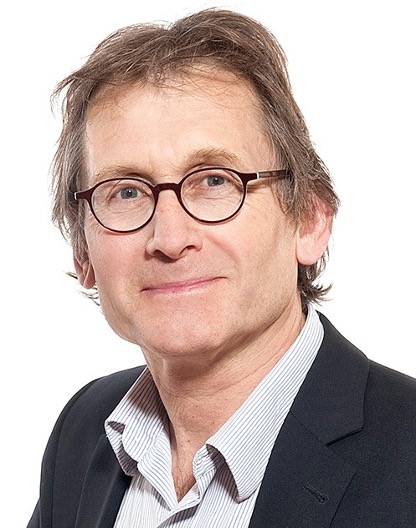
Ben L. Feringa
Ben L. Feringa’s biography
Inspired by Nature’s principles of catalysis, molecular assembly, recognition, transport and motion, the goal of Ben L. Feringa’ work is to exploit the full potential of synthetic chemistry to create new structures with dynamic and adaptive functions.
He obtained his PhD degree at the University of Groningen in the Netherlands under the guidance of Professor Hans Wynberg. After working as a research scientist at Shell in the Netherlands and the UK, he was appointed lecturer and in 1988 full professor at the University of Groningen and named the Jacobus H. van’t Hoff Distinguished Professor of Molecular Sciences in 2003. He is member and former vice-president of the Royal Netherlands Academy of Sciences. He was elected Foreign Honorary member of the American Academy of Arts and Sciences, The German Academy Leopoldina, the Chinese National Academy of Sciences, Foreign member of the Royal Society (London) and Member of the US National Academy. In 2024 he was elected member of the American Philosophical Society (Philadelphia).Ben Feringa is member of European Research Council ERC. In 2008 he was appointed Academy Professor and was knighted by Her Majesty the Queen of the Netherlands and in 2016 promoted to Commander in the order of the Dutch Lion. Feringa’s research has been recognized with a number of awards including the Koerber European Science Award (2003), the Spinoza Award (2004), the Prelog gold medal (2005), the Norrish Award of the ACS (2007), the Paracelsus medal (2008), the Chirality medal (2009), the RSC Organic Stereochemistry Award (2011), Humboldt award (2012), the Nagoya gold medal (2013), ACS Cope Scholar Award 2015, Chemistry for the Future Solvay Prize (2015), the August-Wilhelm- von-Hoffman Medal (2016), the Tetrahedron Prize 2017, the Euchems gold medal and the 2016 Nobel Prize in Chemistry (jointly with J.-P. Sauavage and Sir J.F. Stoddart).